
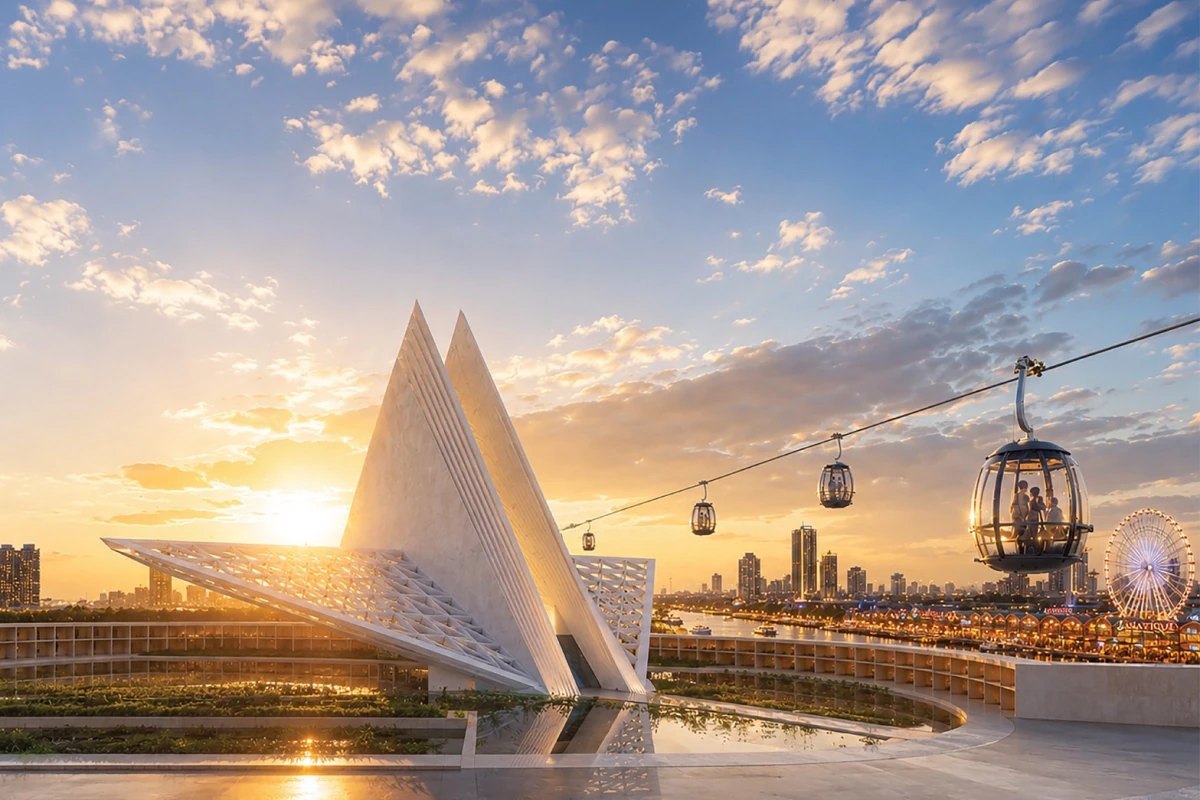
The announcement of MONA Bangkok is not just another item in the cultural calendar. On July 10, 2026, Asset World Corporation (AWC), one of Thailand's major hospitality and property groups, announced a collaboration with MONA, the Museum of Old and New Art in Hobart, Tasmania, to develop a new immersive art museum on the Chao Phraya River. The project is tied to a wider riverside transformation linking Asiatique The Riverfront Destination with a future AWC mixed-use development on the Charoen Nakhon side of the river.
For Bangkok, this matters because it brings together three unusually powerful forces: AWC's tourism and real-estate reach, MONA's provocative museum identity, and a plan to turn a section of the river into a cultural route rather than a scenic backdrop. Many details are still unconfirmed, but the official sources already show why artists, curators, visitors, collectors and cultural institutions in Bangkok should pay attention.
What Has Been Confirmed
AWC's official announcement confirms that MONA Bangkok will be developed in partnership with MONA, the Australian institution founded by David Walsh. AWC describes the project as an immersive, unconventional art museum and a future international destination for contemporary art, culture and experience-led tourism. It will be connected to Asiatique The Riverfront Destination by a cross-river cable car, which AWC describes as the world's first sustainable cross-river themed cable car of this kind.
The same announcement places the museum inside a larger riverside plan: Asiatique on one bank, a new AWC mixed-use development on the Charoen Nakhon bank, and the Chao Phraya River as the central experience corridor. AWC says the cable car represents an investment of more than 2 billion baht. It is presented as an energy-efficient system, designed without support towers in the river, and framed as an experience of light, sound, technology, nature and architecture rather than only a transport link.
The guest list also shows the political and diplomatic weight behind the announcement. AWC names Thailand's Minister of Culture Sabeeda Thaised, Tourism Authority of Thailand Governor Thapanee Kiatphaibool, Bangkok Governor Chadchart Sittipunt, Tasmanian Premier Jeremy Rockliff, Australia's ambassador-designate to Thailand Pablo Kang, and senior figures from MONA and AWC. On the MONA side, the central names are David Walsh, Kirsha Kaechele and Leigh Carmichael, DarkLab director and the lead figure attached to MONA Bangkok. On the AWC side, Wallapa Traisorat and Michael Hariz are the key public voices for the project.
An Agreement, Not an Open Museum Yet
The language matters. The current announcements refer to an agreement and a project in development, not to an already completed museum. ABC News notes that the project is not yet under construction. The Art Newspaper reports that Leigh Carmichael has described 2029 as a target opening date, while also making clear that this is an optimistic timeline. Pulse Tasmania reports that no official opening date has been announced. The responsible reading is therefore simple: MONA Bangkok has been announced, the agreement has been signed, the location and concept are public, but the final opening date, approvals, inaugural programme, ticketing, operating model and full governance details are not yet public.
That distinction is important for Bangkok readers. Large cultural and property projects often change between the first rendering, the launch event and the final opening. The images released by AWC show a dramatic architectural form, a strong presence on the river and a cable car experience, but they should be understood as official project renderings and launch visuals rather than photographs of a completed building.
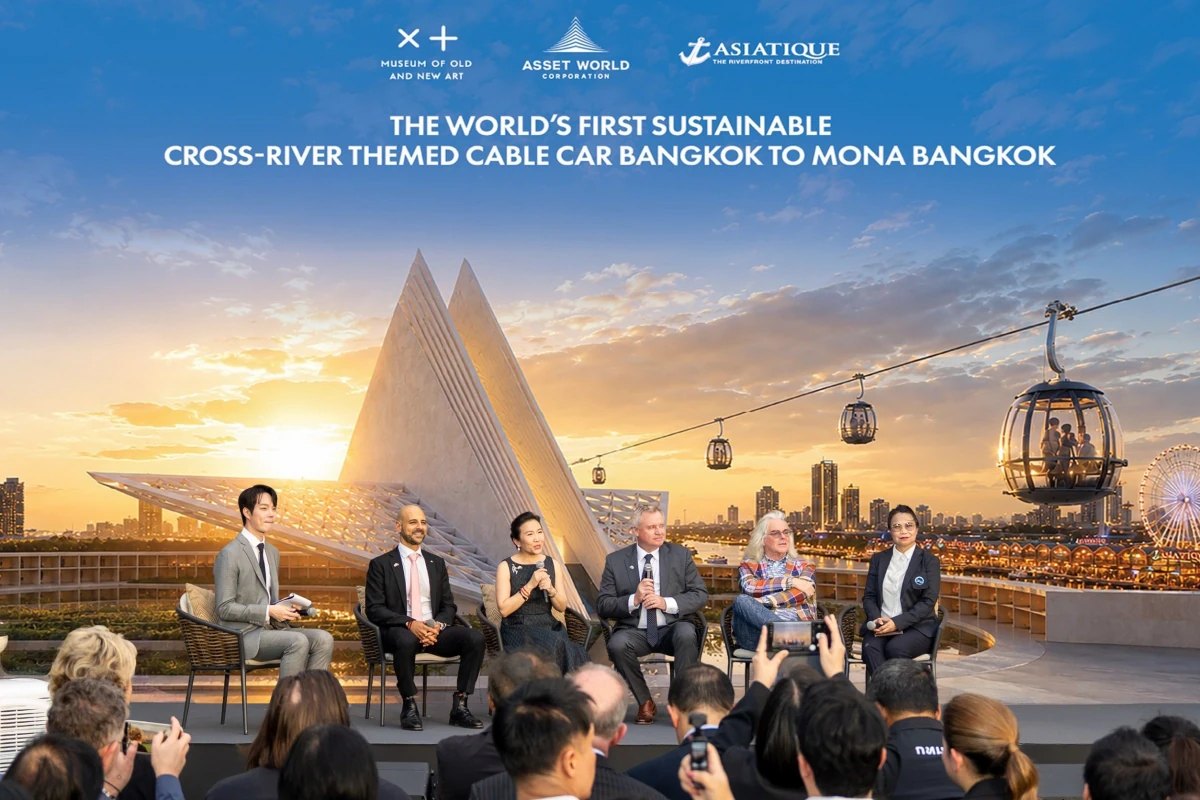
Why MONA Matters
MONA is not a neutral museum brand that can simply be dropped into any city. Opened in 2011 in the northern suburbs of Hobart, on the Moorilla estate, the Museum of Old and New Art has become one of Australia's most recognisable private cultural institutions. It is closely associated with David Walsh's collection and with a distinctive way of mixing antiquities, modern art, contemporary art, technology, provocation, dark humour, underground architecture, festivals, music, food and hospitality.
AWC's announcement highlights MONA's "The O" technology, a digital interpretation system that replaces traditional wall labels with a more personal and exploratory visitor experience. That detail says a lot about MONA's wider philosophy. The museum does not only display objects; it builds a relationship between space, visitor, information and feeling. DarkLab, MONA's creative incubator, has also developed Dark Mofo, the Odeon Theatre and In The Hanging Garden in Hobart. That places MONA Bangkok in a broader category than a conventional gallery. If it follows the spirit of Hobart, it could combine exhibitions, commissions, performances, architecture, hospitality, evening culture and event programming.
This matters in Bangkok because the city's most active contemporary art spaces do not all operate like classic museums. Bangkok's art ecosystem already includes public centres, private foundations, commercial galleries, independent rooms, hybrid venues, former industrial buildings, design centres and temporary programmes. MONA Bangkok could add a highly visible destination, but its success will depend on whether it can speak with that ecosystem rather than simply import an Australian cultural brand.
Not a Copy of Hobart
The official messaging repeatedly stresses that MONA Bangkok is not intended to be a copy of MONA Hobart. AWC says the project will be created specifically for Bangkok, in dialogue with local artists, audiences, traditions and ideas. Leigh Carmichael, quoted by AWC and ABC News, says MONA Bangkok will bring MONA's creative spirit into a new context, present international artists and create opportunities for dialogue with Thai artists, audiences and cultural traditions.
That point will be decisive. A cultural franchise that only copies its original model risks becoming a spectacular but shallow object. A project that lets Bangkok change it can become much more interesting. The river, heat, temples, markets, luxury towers, traffic, riverside communities, mass tourism, emerging artists, independent galleries and Thai audiences are not decorative context. They are the context. If MONA Bangkok wants to be more than an international attraction, it will need to let those realities shape the programme.
The announced focus on light could be productive here. Carmichael has discussed light as both a physical phenomenon and a metaphor. In Bangkok, that subject can be rich: river light at sunset, neon, temple reflections, screens, air pollution, monsoon weather, spirituality, tropical shade, cinema, photography, lanterns, shopfronts and ceremony. The question is whether light becomes a serious artistic spine for the museum, or only a visual signature for a tourism project.
AWC's Role and the Operating Model
The Art Newspaper adds an important detail about the structure of the agreement. According to its interview with Leigh Carmichael, AWC will build, own and operate the museum, while MONA will take responsibility for architecture, curation, collection, commissions and exhibition design. The same article mentions a 15-year agreement with an option to extend for five more years. That is a different model from Hobart, where MONA is tightly linked to its founder, site and local cultural economy.
For Bangkok, this model has both advantages and risks. The advantage is clear: AWC has the property, hospitality, commercial and tourism expertise needed to deliver a large destination project. The group already controls major assets in Thailand, and Asiatique is a recognised destination for residents and tourists. The risk is just as clear: a museum attached to a major developer has to prove that artistic programming is not merely being used to animate a commercial complex.
AWC's public promise is to create long-term value for tourism, communities and Thailand. That language is ambitious, but it will need to be tested in concrete choices: access for local audiences, commissions for Thai artists, transparent artist fees, Thai and English interpretation, ticket pricing, public transport links, integration with riverside neighbourhoods, the real sustainability of the cable car, and space for artists whose work is not already validated by the international market.
Why the Chao Phraya Location Is Strategic
The Chao Phraya is more than a photogenic location. It is one of Bangkok's historical, tourist and urban spines. It connects temples, hotels, markets, old neighbourhoods, shopping centres, luxury residences, converted warehouses and river transport. It also allows the museum to be imagined as an arrival experience. In Hobart, MONA is famously connected to the city by ferry; in Bangkok, AWC and MONA can work with a different culture of movement, combining boats, bridges, cable car cabins and skyline views.
The cable car is therefore a narrative device as much as infrastructure. AWC presents it as an immersive river crossing connected directly to MONA Bangkok. If built as announced, visitors will not simply arrive at the museum; they will pass through a constructed visual sequence across the river. That could be powerful for Bangkok's image. It will also need scrutiny: impact on the river landscape, integration with existing transport, accessibility for residents, tourist flow management and the relationship with riverside communities.
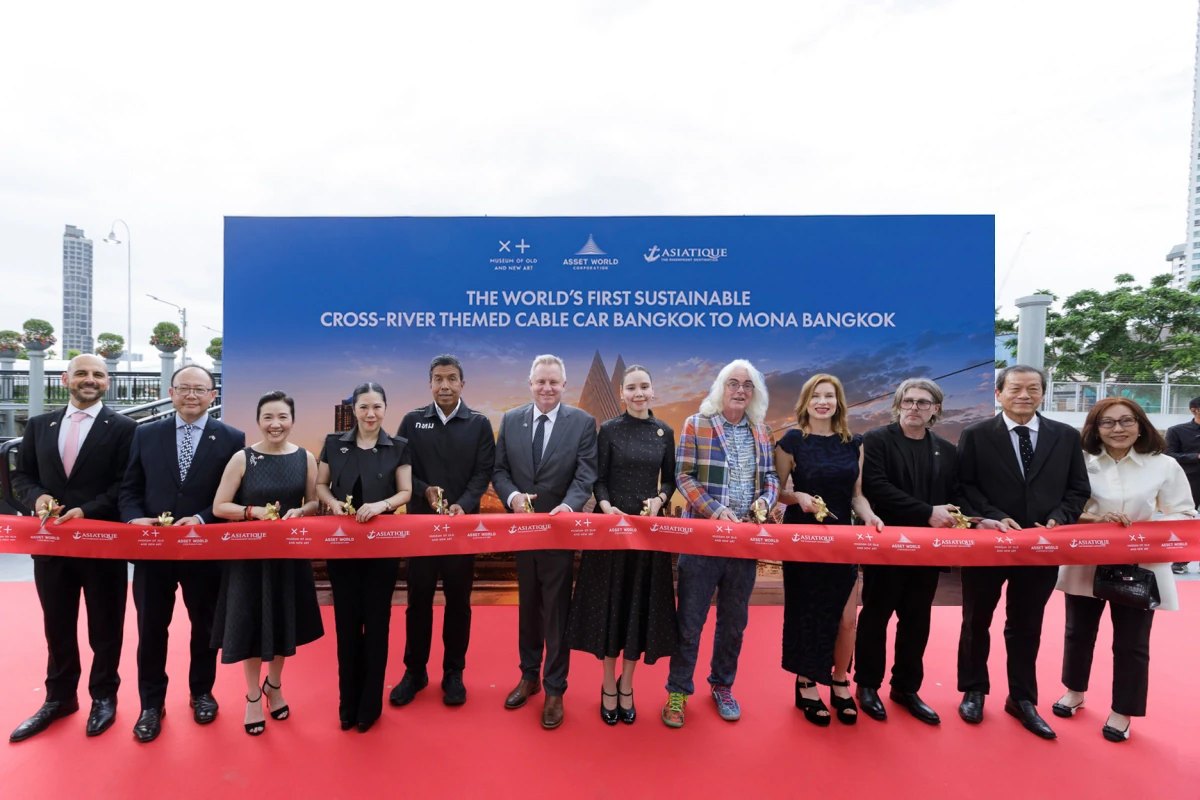
Bangkok and the Competition Between Cultural Capitals
MONA Bangkok arrives at a moment when Thailand's capital is consolidating its position as a contemporary art city in Southeast Asia. Bangkok Art and Culture Centre opened to the public in 2008 and remains a central reference point thanks to its location near Siam and BTS National Stadium. MOCA Bangkok opened in 2012 and gives major space to modern and contemporary Thai art. Dib Bangkok, a new international contemporary art museum, announced its opening at the end of 2025, with its first exhibition "(In)visible Presence" running into 2026. Add to that River City Bangkok, Bangkok Kunsthalle, Jim Thompson Art Center, SAC Gallery, 100 Tonson Foundation, Nova Contemporary, ATT 19, Bangkok CityCity Gallery, the biennales and a much denser independent gallery scene than the city had ten years ago.
In this context, MONA Bangkok could play several roles. For international visitors, it could become a spectacular gateway to art in Bangkok. For local artists, it could create commissions, visibility and dialogue with international curators. For collectors and media, it could strengthen the idea that Bangkok is no longer only a transit or leisure city, but a serious cultural destination. For existing institutions, it could be a partner, competitor and accelerator at the same time.
The most interesting question will be circulation. Will a visitor attracted by MONA Bangkok continue to BACC, MOCA, Dib Bangkok, Charoen Krung galleries or independent spaces? Or will the museum sit inside a self-contained destination bubble? The answer will depend on programming, partnerships, communication and the willingness to connect the museum to the real city around it.
What It Could Mean for Thai Artists
AWC's announcement promises a platform for cultural exchange that will give Thai and international artists opportunities to create and present work on an international stage. That sentence is important, but it needs mechanisms behind it. For Thai artists, the questions are practical: will there be production commissions? Residencies? Transparent artist fees? Open calls? Collaborations with art schools? Critical texts in Thai? Accessible archives? Off-site programmes? Connections beyond Bangkok into other regions of Thailand?
MONA has a reputation for boldness, but boldness is not only provocation. It can also mean giving time, space and resources to artists working with difficult subjects: memory, environment, inequality, spirituality, bodies, gender, history, politics, urbanisation, displacement, craft, technology and the ecology of the river. If MONA Bangkok wants to be genuinely specific to Bangkok, Thai artists cannot simply be invited to decorate the destination. They need room to question it.
Cultural Tourism: Opportunity and Caution
From a tourism point of view, the project is powerful. Tasmanian Premier Jeremy Rockliff sees MONA Bangkok as a way to strengthen links between Tasmania and Thailand, and also to encourage Asian visitors to discover MONA in Hobart. AWC places MONA Bangkok inside a strategy of sustainable tourism, experience-led travel and riverside transformation. The two narratives meet: art becomes a driver of destination branding, territorial identity and international relations.
That can benefit Bangkok if it brings visitors who stay longer, spend in cultural venues, explore several neighbourhoods and discover local artists. It can also become a problem if art is reduced to a luxury image used to sell property, hotels and premium experiences. The difference will sit in the balance between spectacle and substance. A museum can be visually spectacular without being empty. It can be popular without becoming simplistic. It can be commercially viable without giving up curatorial seriousness.
What Is Still Unknown
Several important details are still not officially confirmed. The final opening date is not fixed. The overall museum budget is not fully detailed in the official sources reviewed, even though the cable car is announced as a project of more than 2 billion baht. The total floor area, final architects, collection strategy, inaugural programme, proportion of Thai artists, ticket prices, membership model, opening hours, accessibility commitments, environmental measures and urban approvals all remain to be watched.
The language will also need scrutiny. "Sustainable", "immersive", "world-class", "cultural hub" and "creative destination" are common words in major development announcements. They only become credible when attached to verifiable choices. For Art Bangkok, the editorial task is to stay factual: state what is confirmed, identify what is ambition, and return to the story when plans, timelines, artists or visitor details are published.
Quick Timeline
- 2011: MONA opens in Hobart, Tasmania, and becomes one of Australia's most visible private cultural institutions.
- 2025: AWC and MONA build momentum after a Tasmanian Government trade and investment mission, according to the Tasmanian Premier's statement.
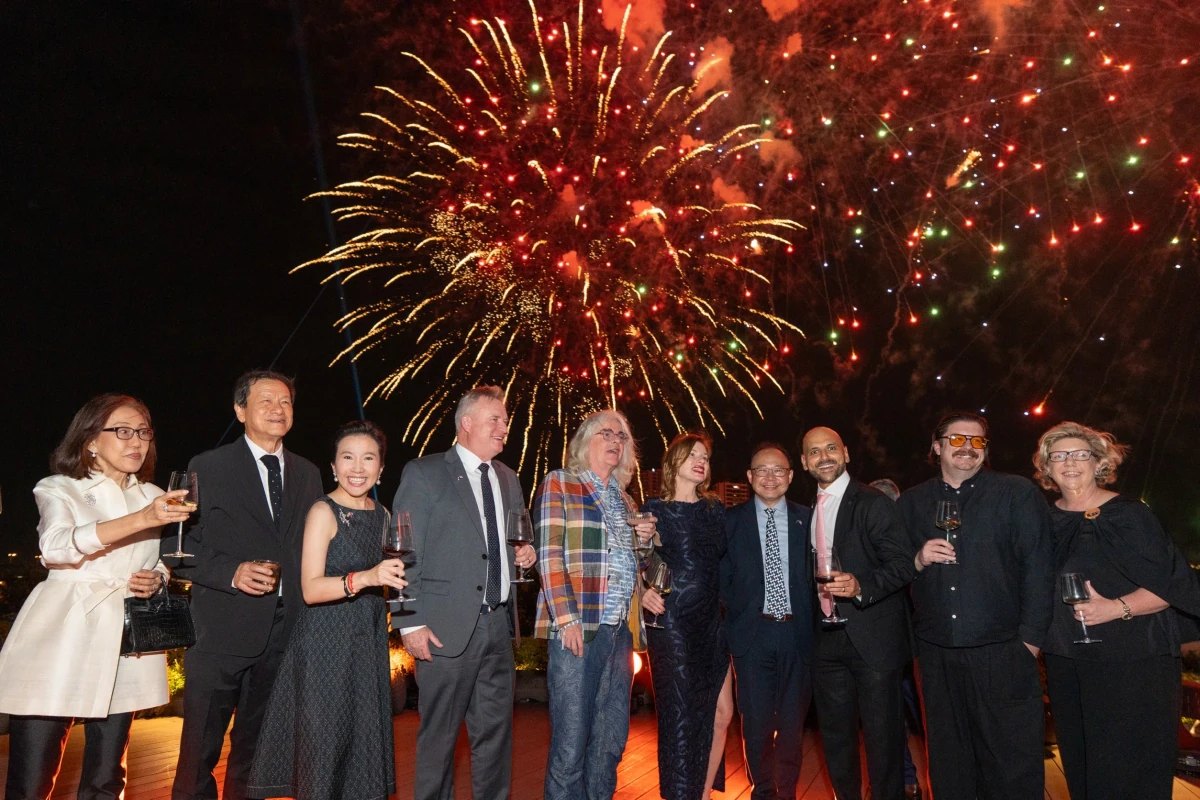
- July 10, 2026: AWC announces two linked Bangkok projects: MONA Bangkok and a sustainable themed cable car connecting Asiatique with the future Charoen Nakhon development.
- 2026: Current sources indicate that the project has been announced but is not yet under construction.
- 2029: The Art Newspaper reports a target opening date mentioned by Leigh Carmichael, while making clear that the date is optimistic.
What Readers Should Watch Next
For Bangkok residents, the project is worth following now, but it should not yet be treated as a place to visit. The next useful details will be the exact site plan, updated renderings, construction schedule, artist calls, local partnerships and the final design of the cable car experience. For travellers, MONA Bangkok could eventually become another reason to spend more time with the city's art scene, alongside BACC, MOCA, Dib Bangkok, River City Bangkok and the galleries around Charoen Krung.
For artists, curators and galleries, this is a strategic moment. A project of this size can shift visitor flows and media attention. It can also open conversations about Bangkok's place in international art networks. The point is not to wait passively for the opening. Local institutions, schools, independent artists and alternative spaces all have reasons to enter the conversation before the programme is fully defined.
Why Art Bangkok Will Keep Following This Story
Art Bangkok usually follows the exhibitions, artists and venues that shape the city's cultural life. MONA Bangkok deserves close attention because it touches several central questions: how Bangkok presents itself to the world, how developers use art, how private museums transform neighbourhoods, how Thai artists can access international platforms, and how the river becomes a cultural experience space.
Our editorial position is simple: welcome the ambition, but keep the critical lens. If MONA Bangkok delivers a museum that is genuinely specific to Bangkok, open to local artists and capable of serious curatorial work, it could become one of the cultural turning points of the decade. If artistic substance falls behind architecture and marketing, it will become another spectacular attraction. The difference will be visible in the details: who is invited, who is paid, who can enter, which stories are told and how the museum places itself inside the city.
References
- Official AWC announcement: two landmark projects for Bangkok's riverside, cable car and MONA Bangkok
- Premier of Tasmania: MONA Bangkok shines global spotlight on Tasmania
- ABC News: Hobart's Mona announces plans to set up new art gallery in Bangkok
- The Art Newspaper: Tasmania's Museum of Old and New Art announces plans for Thailand outpost
- AAP News: Version of Australia's famed MONA destined for Bangkok
- Pulse Tasmania: MONA expanding to Bangkok in major cultural partnership
- BACC: Bangkok Art and Culture Centre
- Dib Bangkok: official site
- MONA: Museum of Old and New Art official site
To plan a wider Bangkok art route, explore Bangkok artists, Our Gallery and About Art Bangkok.