
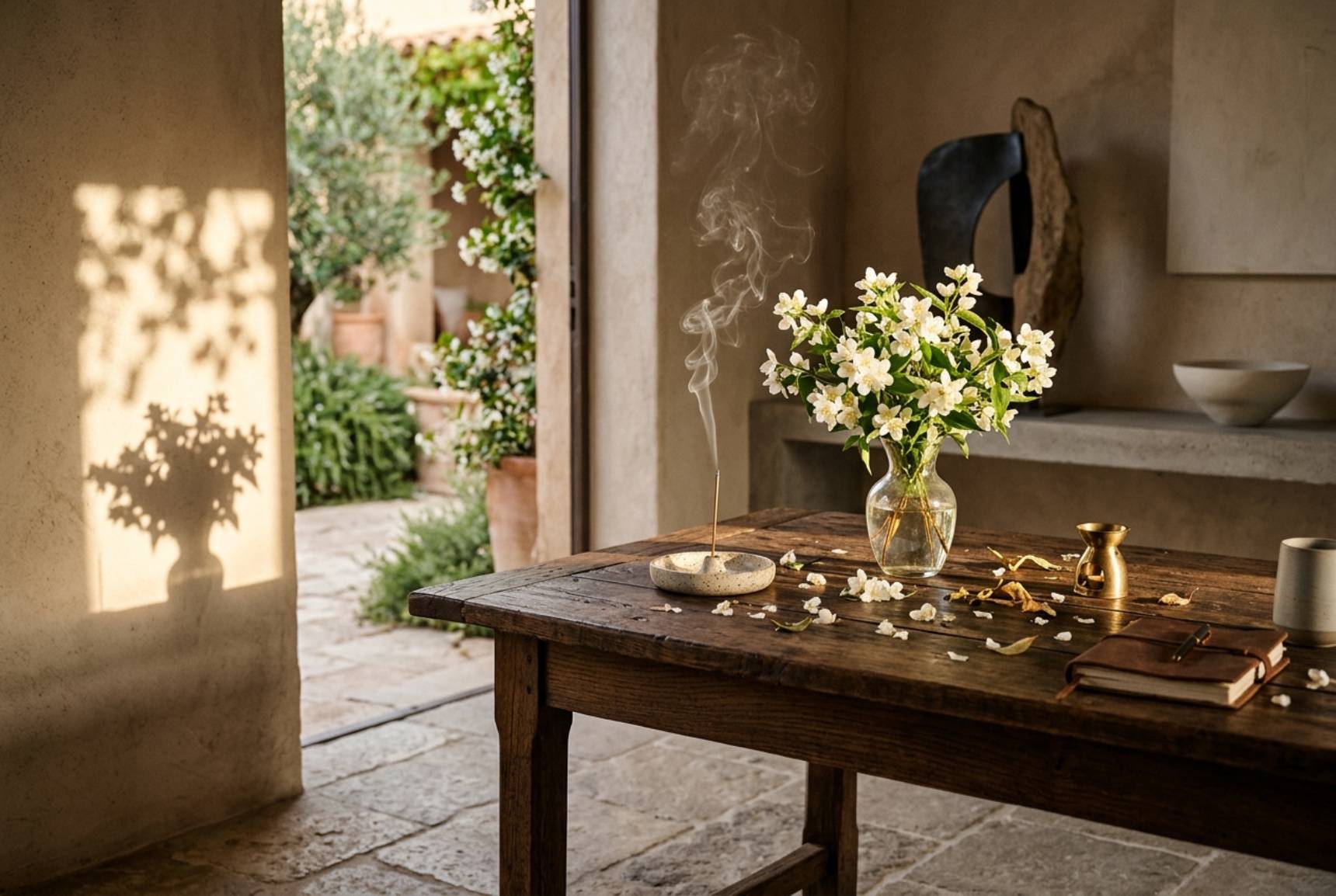
A familiar fragrance can transport us to another place before we have consciously identified it. The scent of rain on warm pavement may recall an afternoon from childhood. The aroma of jasmine may evoke a quiet garden, while the delicate fragrance of old wood can bring back the atmosphere of a house that no longer exists. Unlike photographs or written words, scents often reach us without warning, carrying fragments of the past into the present.
Fragrance occupies a unique position in the human experience. It is invisible, intangible, and difficult to describe precisely, yet it can influence how we remember places, perceive environments, and experience the passage of time. A single scent can transform an ordinary room into a landscape of personal associations, connecting the physical world with the architecture of memory.
For artists, designers, and those interested in the relationship between sensory experience and creative expression, fragrance offers a compelling way to understand how people inhabit spaces. It reminds us that our surroundings are never experienced through sight alone. They are also shaped by the sensations, emotions, and memories we bring into them.
Why Smell Is So Closely Connected to Memory
The relationship between smell and memory is rooted in the organization of the brain. When we encounter a fragrance, information from the olfactory system travels through neural pathways connected to regions involved in emotion and memory, including the amygdala and hippocampus.
The amygdala plays an important role in emotional processing, while the hippocampus contributes to forming and retrieving memories. Their close functional relationship with olfactory processing helps explain why certain scents can evoke unusually vivid emotional recollections.
Psychologists sometimes describe this phenomenon as the Proust effect, named after French writer Marcel Proust. In his novel In Search of Lost Time, the taste and aroma of a madeleine dipped in tea unexpectedly awaken an extensive series of childhood memories. The episode captures something familiar to many people: a sensory experience can unlock a past that deliberate recollection alone might struggle to reach.
A fragrance does not necessarily reproduce an entire memory exactly as it happened. Instead, it may reactivate an association, an emotional atmosphere, or a collection of sensory impressions. The remembered place might seem vivid even when certain details have changed over time.
This makes scent particularly fascinating as a subject of artistic exploration. It reveals that memory is not simply an archive of images. It is an evolving experience shaped by emotion, sensation, and interpretation.
Fragrance and the Experience of Time
Time is usually measured through clocks, calendars, and the sequence of events. Yet our subjective experience of time is far more flexible. A few seconds can feel endless during a moment of anxiety, while an entire afternoon may disappear when we are absorbed in an engaging activity.
Fragrance can contribute to this subjective experience by connecting the present with events from the past. When a familiar aroma evokes an earlier period of life, different moments can appear to coexist. The present environment becomes a meeting point between what is happening now and what has already happened.
Consider the smell of freshly brewed coffee. For one person, it may suggest the beginning of a working day. For another, it may recall long conversations with a grandparent or mornings spent in a family kitchen. The fragrance itself does not contain a universal meaning. Its significance emerges from the personal experiences attached to it.
Scent can also influence the perceived character of a moment. A delicate floral aroma may contribute to a sense of softness and intimacy, while the dry scent of paper and wood can suggest age, permanence, or quiet contemplation. These associations are subjective rather than fixed, but they can shape how an environment is interpreted.
In this way, fragrance becomes a subtle instrument for expressing time. It can make a new space feel familiar, bring an old experience into the present, or encourage us to pause and become more attentive to a moment that might otherwise pass unnoticed.
The Scent of a Place: How Fragrance Shapes Space
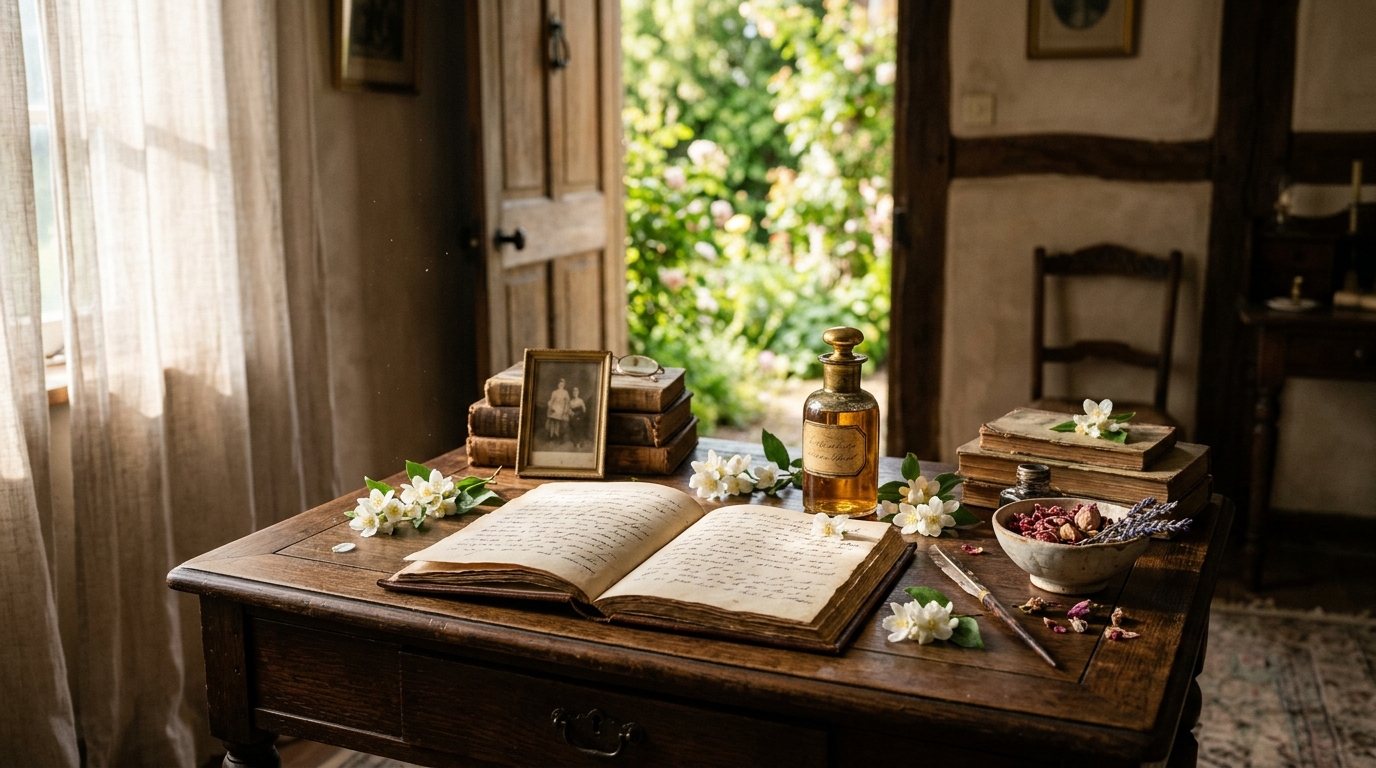
Every environment has a sensory identity. Architecture defines its dimensions, lighting establishes its visual character, materials contribute texture, and sound influences its atmosphere. Fragrance adds another layer to this experience, creating associations that may remain long after a person has left the space.
Imagine entering a library filled with the scent of paper, leather, and polished timber. These aromas may reinforce an impression of history, concentration, and intellectual discovery. A courtyard scented with citrus blossoms can feel open and refreshing, while the fragrance of incense in a dimly lit room may encourage a quieter, more contemplative mood.
Such responses are not universal. Cultural background, personal memories, familiarity, and individual preferences all influence how a scent is interpreted. Nevertheless, fragrance can become an important part of how a place is recognized and remembered.
This idea has particular relevance to architecture and interior design. A room is not experienced as a collection of visual elements alone. It is encountered through movement, temperature, sound, touch, and smell. These sensations combine to create a sense of being somewhere.
Designers can consider this multisensory dimension when selecting materials, planning ventilation, or deciding whether a space should have a distinctive scent. Natural materials, fresh air, planted courtyards, and carefully considered botanical elements may contribute to an environment's sensory character without overwhelming its occupants.
The objective is not necessarily to introduce fragrance into every room. Sometimes the absence of a strong scent is equally important. A neutral environment can allow natural materials, changing daylight, and the presence of people to define the atmosphere.
The Invisible Architecture of Emotion
Fragrance can influence the emotional character of a space, but its effect depends on context. The same aroma may feel comforting in one setting and intrusive in another. A fragrance associated with a beloved person may evoke warmth, while an identical scent encountered during an unpleasant experience may produce discomfort.
This relationship between smell and emotional association suggests that fragrance can be understood as a form of invisible architecture. It does not create physical walls or alter the dimensions of a room, but it can change how that room feels and what it means to the people inside it.
In galleries, museums, hospitality environments, and immersive installations, scent can become part of a carefully composed sensory experience. An artist might explore the contrast between the smell of fresh flowers and the appearance of their gradual decay. A spatial installation might use the aroma of soil, leaves, or wood to investigate the relationship between nature and the built environment.
Such approaches require restraint and consideration. Strong or unfamiliar scents can distract visitors, trigger sensitivities, or interfere with the experience of others. Fragrance is most effective as an artistic element when its presence has a clear purpose and when visitors can choose how closely they engage with it.
The possibilities are nevertheless significant. By working with scent, artists can explore emotions that are difficult to express through visual form alone: longing, intimacy, absence, nostalgia, and the fleeting nature of human experience.
Cultural Landscapes and the Meaning of Scent
Fragrance is also shaped by cultural practices and shared traditions. Certain aromas become associated with ceremonies, celebrations, domestic routines, religious spaces, or seasonal changes. Over time, these repeated experiences contribute to a collective understanding of place and belonging.
In Thailand, the fragrance of jasmine may evoke floral offerings, gardens, or familiar domestic settings. Incense can be associated with spiritual practices and moments of reflection, while the aromas of tropical vegetation and rain can contribute to memories of particular landscapes.
These associations vary among individuals and communities, and no single scent represents an entire culture. Their significance lies in the relationships people develop with the environments and practices in which they encounter them.
Across different societies, fragrance has also played a role in hospitality, ritual, personal adornment, and the preparation of living spaces. Flowers, aromatic woods, herbs, and resins have been used in different ways to mark occasions, establish atmospheres, and communicate meaning beyond spoken language.
For contemporary artists and designers, these traditions offer opportunities to investigate how sensory experiences connect personal identity with cultural history. A scent-based artwork might explore migration, inherited traditions, the changing character of a neighbourhood, or the relationship between memory and home.
Approaching these subjects thoughtfully requires attention to context. Rather than treating cultural aromas as decorative symbols, artists can examine the histories, practices, and personal experiences that give them meaning.
Scent as an Artistic Medium
Visual art has long explored memory through portraits, landscapes, found objects, archives, and representations of familiar places. Fragrance introduces another possibility: instead of depicting a memory, an artwork can create the conditions in which a visitor begins to recall one.
A scent-based installation might use the aroma of damp earth to evoke a garden, or the smell of aged paper to suggest an archive of forgotten stories. An artist could combine fragrance with sound, lighting, photography, or sculptural materials to create an environment that changes as visitors move through it.
Unlike a fixed image, scent is difficult to contain within a precise boundary. It moves through the air, changes in intensity, and may be experienced differently depending on a visitor's position and sensitivity. This makes fragrance a particularly interesting medium for exploring movement and the relationship between bodies and space.
Scent also introduces an element of uncertainty. Visitors may recognize an aroma immediately, or they may experience a vague emotional response without knowing why. Two people standing in the same installation can encounter entirely different memories.
This openness can become part of the work's meaning. The artwork provides a shared sensory starting point, while each visitor contributes a personal history that cannot be fully reproduced or controlled.
The result is an art experience that exists partly in the physical environment and partly in the mind.
Designing with Fragrance: Subtlety Over Intensity
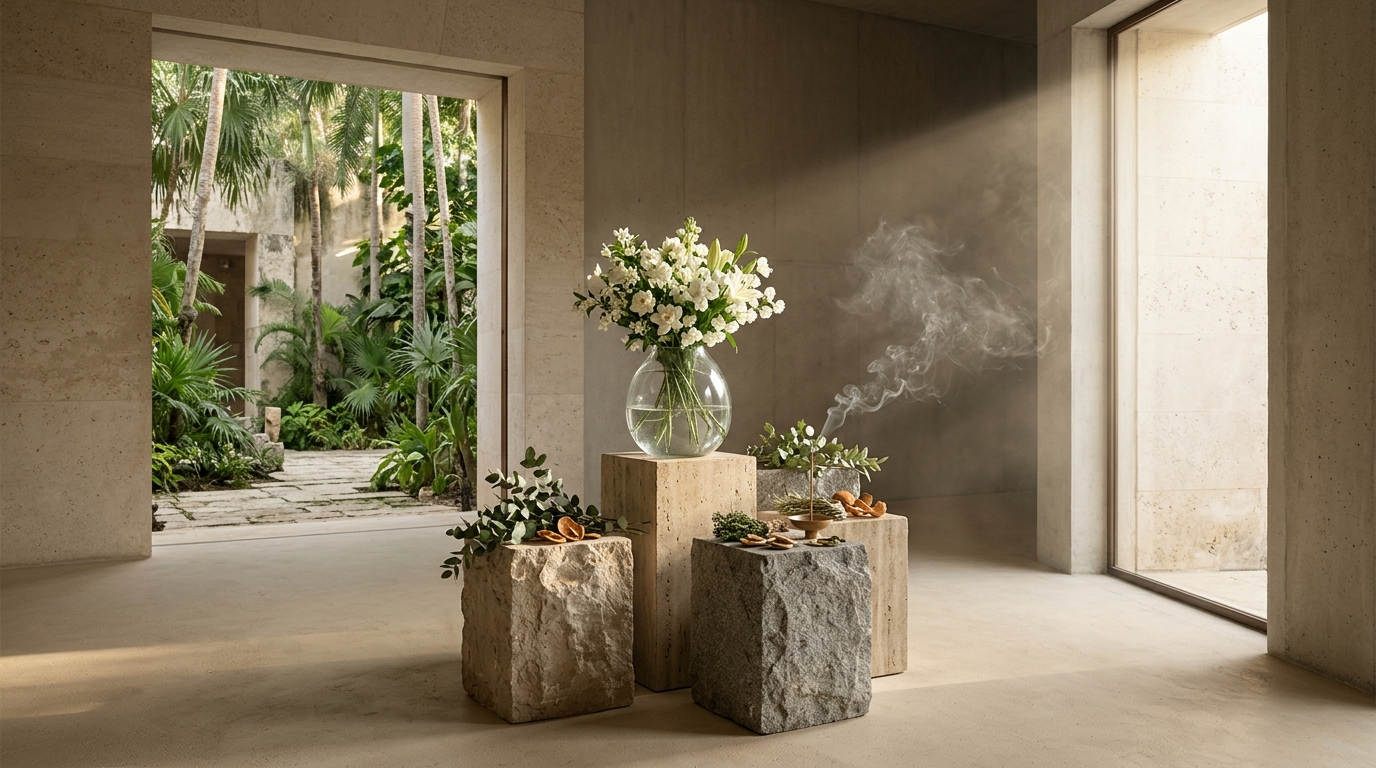
The growing interest in multisensory design invites a more thoughtful approach to fragrance in galleries, homes, cultural spaces, and places of hospitality. However, effective sensory design does not require a signature aroma in every environment.
A carefully chosen scent should support the character of a space rather than compete with it. Natural ventilation, low-intensity aromatic materials, and the use of plants or flowers may provide more appropriate solutions than continuous artificial fragrance.
Designers should also consider accessibility. Some visitors experience migraines, asthma symptoms, allergies, or sensory discomfort in response to scented environments. Where fragrance forms part of an exhibition or installation, clear information and an alternative route or unscented viewing option can help make the experience more inclusive.
There is also an important distinction between a pleasant smell and a meaningful sensory experience. A room may smell beautiful without leaving a lasting impression. Conversely, the subtle aroma of a familiar material may carry personal significance far beyond its immediate sensory qualities.
The most thoughtful approach recognizes that fragrance is not simply an accessory. It is one element within a larger relationship between people, materials, memories, and place.
The Future of Sensory Art and Spatial Experience
As contemporary art and design continue to explore experiences beyond the visual, fragrance offers new ways to think about exhibitions, interiors, public environments, and storytelling. Artists can use scent to examine the relationship between human perception and environmental change, while designers can investigate how sensory qualities influence the experience of buildings and shared spaces.
Digital technologies may help document, describe, or recreate certain aromatic experiences, although reproducing a scent and reproducing the personal memory associated with it are two very different challenges. A fragrance can be formulated or delivered, but the emotional associations it awakens remain dependent on the person encountering it.
This distinction is important. The future of scent-based art does not necessarily lie in producing perfectly standardized experiences. It may instead lie in creating environments that allow individual responses to emerge.
A gallery could become a place where visitors encounter the scent of a changing landscape. An architectural project might explore how materials age and develop distinctive aromas. An installation could invite reflection on the smells associated with a home that has disappeared or a natural environment undergoing transformation.
These possibilities position fragrance as more than a sensory effect. It becomes a way to ask questions about time, identity, impermanence, and the ways human beings create meaning from their surroundings.
When a Fragrance Becomes a Memory
Perhaps the most remarkable quality of fragrance is its ability to make an invisible experience feel unexpectedly close. A familiar aroma can bring a distant moment into focus, while an unfamiliar one can create a new association that may remain meaningful for years.
The scent does not stop time, nor does it preserve the past exactly as it was. Instead, it creates a connection between present sensation and remembered experience. The past returns not as a complete reconstruction, but as an impression shaped by emotion, imagination, and the passage of time.
For Art Bangkok, this relationship offers a compelling perspective on the role of the senses in contemporary art and spatial design. It encourages us to look beyond what can be seen and consider how environments are remembered, how emotions become attached to places, and how seemingly ordinary sensations can carry extraordinary personal meaning.
A room may eventually be emptied, a landscape may change, and an object may disappear. Yet a particular fragrance can still awaken the feeling of being there.
In that fleeting encounter between scent and memory, time becomes less like a straight line and more like a space we can briefly enter again.